Think back to being seven or eight years old. You probably drew without asking whether it was good. You made up stories, built things from cardboard, sang while you walked. Nobody had to convince you to be creative; it was simply how you played.
Then somewhere along the way, it quietly stopped. If you now say “I’m not a creative person,” you are in very good company. The good news is that creativity is not a gift some people have and others lack. For most of us, it is a habit we put down, and habits can be picked up again.
Why creativity fades in adulthood
There is rarely one single reason. Usually it is a slow accumulation of small things.
We learn to be judged. At school, drawings and writing are often marked or compared. Many people remember one careless comment that made them put their pencil down for years. Over time, “making something” turns into “making something good enough.”
Life fills up. Work, family, bills and messages take most of our attention. Creative time rarely looks urgent, so it is always the first thing to be pushed to “later”.
We value usefulness. As adults we get used to asking what something is for. Play without a purpose can feel almost guilty, even though it is exactly what refreshes us.
We fear looking foolish. A child paints a purple dog with total confidence. An adult hesitates, because they can already imagine the opinion of someone watching.
What you may be missing without noticing
When creativity goes quiet, it often leaves a small gap. Many people describe feeling a little flat, rushed or “on autopilot”. This is a general observation, not a diagnosis, but it is common for adults to say they feel more like themselves again after making something with their hands, even something simple. Creative time gives your mind a different job for a while, one with no deadline and no right answer.
How to start again, gently
The biggest mistake is starting too big. A grand plan to “paint every weekend” usually collapses by the second week. Start small enough that it feels almost silly.
Lower the stakes
Use cheap paper and a simple pencil, not the beautiful sketchbook you are afraid to ruin. Permission to make something ugly is what unlocks everything else.
Focus on the doing, not the result
Instead of asking “is this good?”, ask “what do I notice?” Notice the sound of the pencil, the way a colour spreads in water, the shape of a leaf on your desk. Attention is the heart of creative work.
Make it part of an ordinary day
Ten minutes after dinner will do more for you than a free afternoon you never find. Put your materials where you can see them, so starting takes no effort.
Small ways to begin this week
- Doodle for five minutes while your tea cools, with no aim at all.
- Draw one object on your table every day, as roughly as you like.
- Choose three colours that match your mood and fill a page with shapes.
- Take a walk and collect a leaf, then paint or trace it at home.
- Write one sentence each evening about something you noticed.
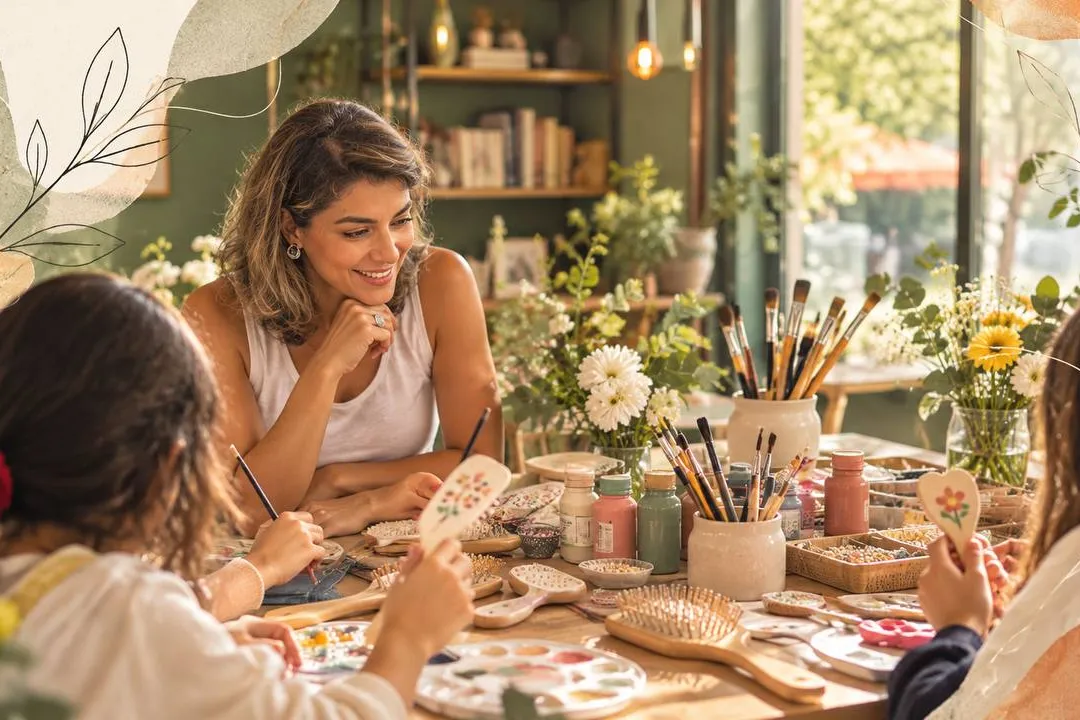
- Try a beginner workshop where the materials and the guidance are provided for you.
When it feels uncomfortable
At first, the inner critic may be loud. That is normal, and it does not mean you are bad at this. Thank it politely, and keep going for one more minute. Creative confidence is not the absence of doubt; it is the willingness to carry on while doubt is still in the room.
It can also help to work alongside other people. Sharing a table with others who are also “just trying” takes away the pressure to perform. If you ever find that low mood or stress feels heavy and constant, creative time is a lovely support, but it is not a replacement for talking with a doctor or a qualified professional.
An invitation
You did not lose your creativity; it has been waiting for you. At Artifyclub we help adults rediscover it in a calm, judgment-free space, using art as a way to grow in confidence and self-understanding. If you would like a guided first step, explore our workshops, read about individual coaching, or write to us and tell us where you are starting from.