By the end of a long day, your head may feel like a browser with forty tabs open. Notifications, deadlines, conversations you are still replaying. In moments like this, many people reach for the phone, which rarely helps. Another option is much older and much quieter: making something with your hands.
You do not need talent for this. You do not even need to like what you make. What matters is the doing.
Why making art can feel calming
Artists and educators have long observed that absorbing hands-on activity gives the mind a break from its usual loop of worries. This is a general observation, not a medical claim. When you are choosing a colour or following a line, your attention has one gentle job, and there is less room for the thoughts that circle.
Many people also find that slow, repetitive movements, like shading, filling a shape, or drawing small patterns, bring a sense of rhythm. Your breathing often slows down without you deciding it should. Think of it as a short pause button that you press with a pencil.
Why “no talent needed” is true
Stress relief through art does not depend on the result. A page of wobbly lines can do the same job as a careful drawing. In fact, the less you try to impress anyone, the better it works.
The pressure to be good is often what keeps adults away from art. So set a different goal: your aim is not a picture, it is a few quiet minutes. If a drawing happens along the way, that is a bonus.
A simple 15-minute exercise
Try this when you feel wound up. You need paper, a pencil and, if you like, a few coloured pens.
- Sit comfortably and take three slow breaths before you begin.
- Draw a large circle or square on the page. This is your “space”.
- Fill it with any shapes, lines or patterns that come to mind, without planning.
- If you like, choose colours that match how you feel right now, not how you wish you felt.
- Keep going until the timer rings, then look at the page for a moment.
- Ask yourself one question: “What did my hand want to do today?”
You do not have to keep the page. Some people like to tear it up afterwards, and that is perfectly fine.
Many people are surprised by how quickly this works. After only a few minutes of focused, playful making, the day often feels a little less sharp at the edges. Even if the page looks messy, the pause itself was the point, and you are allowed to enjoy it without any reason.
Ideas to keep it easy and enjoyable
- Choose a time and place that already exists in your day, such as after dinner or before bed.
- Keep your materials simple and visible: paper, pencils, a small watercolour set.
- Try repetitive patterns, like waves, dots, leaves or spirals, when your mind feels busy.
- Use your non-dominant hand for a minute to loosen perfectionism.
- Put your phone in another room, or at least on silent.
- Play quiet music if it helps, or enjoy the silence if it does not.
- Do not judge, rate or explain what you made. Just let it be there.
Making it a habit, not a rescue plan
Creative time works best as a small, regular companion rather than an emergency tool. Ten minutes a few times a week is more useful than a big session once a month. Over time you may notice that you know your own signals earlier: the tight shoulders, the shallow breathing, the urge to scroll. These are good moments to reach for a sketchbook instead.
A caring note
Art can be a lovely support in everyday life, but it is not a treatment. If your stress feels very heavy, lasts for a long time, affects your sleep or your daily life, or if you feel hopeless, please speak with a doctor or a qualified mental health professional. Creative practice can walk alongside professional care, never in place of it.
Come and try it with us
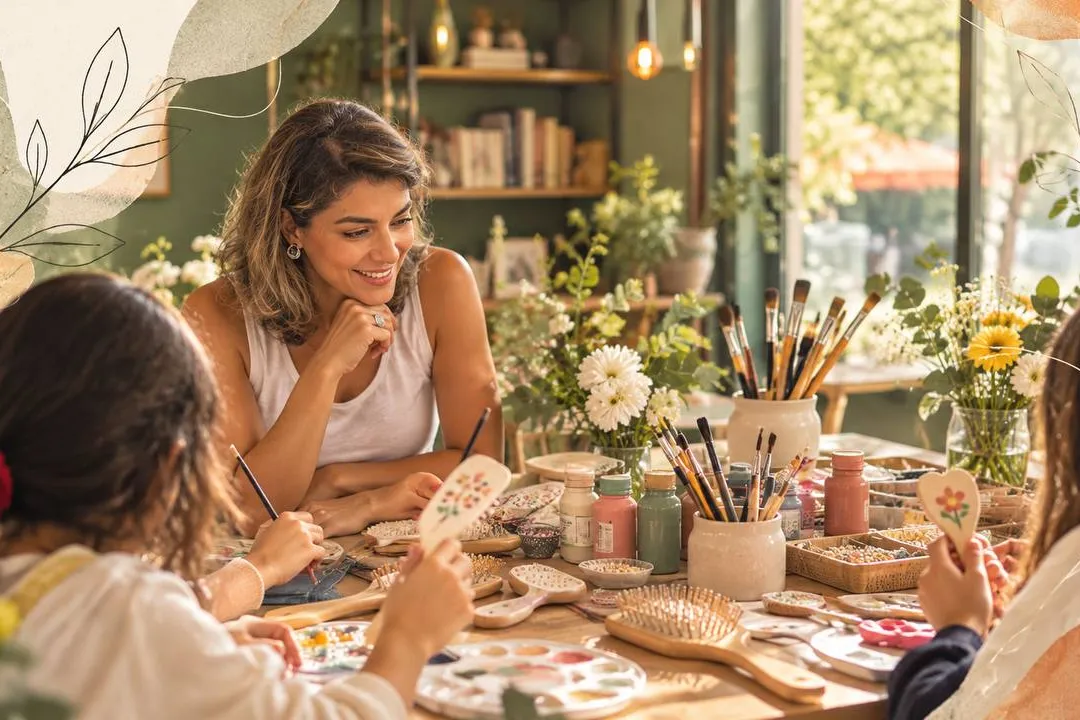
Sometimes it is easier to begin when someone else sets the table and holds the space. At Artifyclub we offer calm, judgment-free sessions where adults use art to slow down and reconnect with themselves. You can look at our workshops, learn about group coaching, or write to us if you have questions. No experience is needed, only a little curiosity.