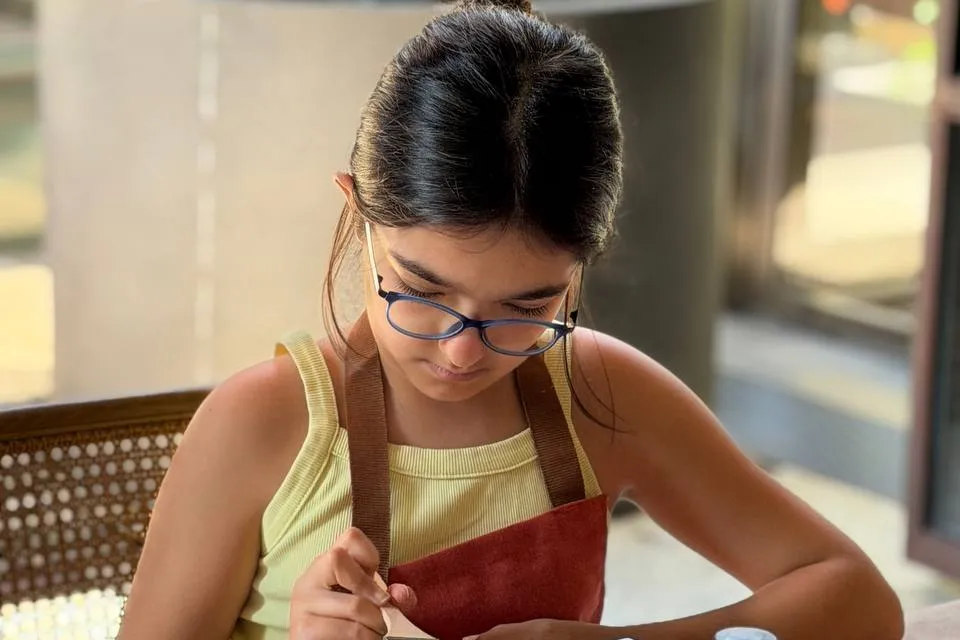
Introduction: Sara’s Story – A Child Lost in Her Own Silence
Sara, an 8-year-old girl, lived in her own world. At school, no one heard her voice. Teachers said she was “very polite and quiet,” and classmates gradually distanced themselves, thinking she didn’t want to talk to them. But Sara’s mother knew the truth was different. Sara wanted to connect with others, but fear of judgment and severe shyness prevented her from even uttering a word.
Sara’s mother, worried about her daughter’s future, searched online for a summer activity for kids that would be both fun and help her come out of her shell. She wanted a summer camp that was more than just a typical children’s art class. Then she discovered Artify and its unique art and coaching approach. Artify’s painting workshops were more than just art lessons; they were a journey for talent development and child creativity alongside life skills.
This article tells the story of Sara’s journey from a shy and withdrawn child to a confident and articulate girl; a journey that began at Artify’s summer art camp and was realized with the guidance of a professional Art Mentor.
Amazing workshops and courses at Artifyclub await children and teenagers! Meet our art coaching specialist and discover your talents!
Part One: Identifying the Problem – Shyness in Children and Its Effects
Shyness is one of the most common behavioral challenges in children and can have profound effects on various aspects of their lives. According to developmental psychology research, approximately 30-40% of children exhibit shy behaviors at some point in their lives. These behaviors may include:
- Avoiding eye contact
- Speaking in a very low voice
- Refusing to participate in group activities
- Severe anxiety in new social situations
- Extreme dependence on parents in unfamiliar environments
- Face turning red when encountering others
- Avoiding situations that require speaking in public
In Sara’s case, these symptoms manifested more acutely. Even when she painted beautiful pictures in her school’s children’s art class, she would refuse to show them to others. Teachers thought she lacked talent, but the reality was different; Sara had great talent, but fear of judgment prevented her from expressing it.
Research has shown that untreated childhood shyness can lead to more serious problems such as social anxiety, depression, and academic decline during adolescence and adulthood. Therefore, timely intervention and effective approaches like coaching through art are crucial.
Signs of Shyness in Children That Parents Should Pay Attention To:
- Avoiding eye contact: The child refuses to look others in the eye
- Speaking in a very low voice: The child’s voice is barely audible
- Social isolation: The child prefers to be alone rather than connect with others
- Anxiety in new situations: The child becomes anxious in unfamiliar environments
- Extreme dependence on parents: The child feels insecure without parents present
- Non-participation in group activities: The child refuses to join games and group activities
Part Two: Discovering Artify and Sara’s Mother’s Decision
After months of searching for a suitable summer activity for kids, Sara’s mother came across Artify’s summer art camp advertisement online. What caught her attention was Artify’s emphasis on life skills alongside painting courses. She read on Artify’s website:
“Here, art is a means, not an end. Through art and coaching, we help children develop self-confidence, emotional intelligence, and problem-solving skills.”
This statement was very appealing to Sara’s mother, who wasn’t just looking for a kids activity to fill summer vacation. She wanted her child to participate in a summer camp that would both develop child creativity and contribute to talent development.
After contacting Artify and speaking with one of the Art Mentors, Sara’s mother realized that this wasn’t going to be just another typical children’s art class. An Art Mentor would carefully observe Sara’s behavior during painting workshops, identify her strengths, and use coaching techniques to help her overcome shyness. Sara’s mother immediately enrolled her daughter in Artify’s summer camp.
Why Did Sara’s Mother Choose Artify?
- Combined art and coaching approach: A blend of art education and life skills development
- Professional Art Mentor: Guidance from an art coaching specialist throughout the program
- Safe and supportive environment: A non-judgmental space for creative expression
- Purposeful program: Each session was designed with a specific goal
- Focus on process, not product: Emphasis on personal growth, not just the final result
Part Three: The First Days – Observation and Creating Safety
On the first day of Artify’s summer art camp, Sara entered the art workshop with eyes full of fear and anxiety. She chose a corner and began to paint without speaking to anyone. But the difference here from other painting courses she had experienced before was in the Art Mentor’s approach.
Ms. Rezaei, Sara’s Art Mentor, decided to take a non-judgmental observation approach rather than immediately approaching Sara and asking her to introduce herself. She spent the first few days observing Sara during painting workshops and showing attention to her paintings without directly speaking to her. Sometimes she would sit next to Sara and paint silently without saying a word.
This behavior gave Sara a sense of safety. She saw that no one was forcing her to speak, and she could freely express her child creativity in the safe environment of the art workshop. This was something she had never experienced in her school’s children’s art class; teachers there expected her to speak in front of others and explain her paintings, but here no one pressured her.
Psychological research has shown that creating psychological safety in shy children is the first and most important step in helping them. Shy children need more time to adapt to new environments, and any pressure or coercion can cause them to withdraw further. The Art Mentor at Artify, understanding this principle, had created a space where Sara felt safe.
Steps Taken by the Art Mentor to Create Safety:
- Non-judgmental observation: Observing and analyzing behavior for the first few days
- Supportive presence: Sitting next to the child without creating pressure
- Attention to artworks: Showing interest in the child’s paintings without criticism
- Creating a safe space: Reassuring the child that there are no mistakes in art
- Patience: Giving the child enough time to get used to the environment
Part Four: Targeted Intervention – Introducing the “Brave Brush”
After three days of observation and building a non-verbal relationship, Ms. Rezaei decided to take the first intervention step. She had noticed that Sara had a great fondness for warm colors (red, orange, and yellow) and was very skilled in using them. During one of the painting workshops, Ms. Rezaei introduced an interesting theme:
“Today, we’re going to paint our pictures with a special brush. Its name is the ‘Brave Brush.’ This brush is only given to those who are ready to try something new, even if they’re not sure about the outcome.”
Then Ms. Rezaei approached Sara and said with a warm smile: “Sara, I think you’re ready to use the Brave Brush. Would you like to try it?” Sara nodded with hesitation but with visible excitement in her eyes.
Using artistic metaphors like the “Brave Brush” is one of the effective coaching techniques in art. These metaphors help children become familiar with abstract concepts like courage and risk-taking without feeling directly targeted. In fact, by using this brush, Sara took a step toward overcoming her shyness without even realizing it.
That day, Sara painted a beautiful sunset with the Brave Brush. When the painting was finished, Ms. Rezaei asked her: “How did you feel when you were painting with this brush?” Sara answered in a quiet but determined voice: “I felt good. Like I could do anything I wanted.”
This moment was a turning point in Sara’s journey. For the first time in a group setting, she had felt a sense of agency; she understood that she could make choices, take risks, and achieve positive results. This is exactly the kind of life skills that art and coaching at Artify aim to develop.
Coaching Techniques Used in This Stage:
- Metaphor creation: Using the “Brave Brush” to conceptualize courage
- Indirect encouragement: Offering suggestions instead of giving orders
- Open-ended questions: Asking “How did you feel?” to increase self-awareness
- Positive feedback: Emphasizing good feelings rather than the painting’s result
- Positive challenge creation: Inviting the child to try something new
Part Five: Expanding Connections – Group Painting and Collaboration
After the success of the previous stage, the Art Mentor decided to gradually introduce Sara to group activities. In the second week of the summer art camp, one of the painting workshops was designed as a group activity. The children had to collaborate to create a large painting on a shared canvas.
Ms. Rezaei carefully arranged the group so that Sara would be with children who had gentle and supportive personalities. She also gave Sara the responsibility of choosing the colors; something Sara was skilled at. This smart choice made Sara feel valued and expert, encouraging her to connect with others.
At first, Sara communicated with others only through gestures and pointing. But gradually, when she saw that others appreciated her choices and the group painting was taking shape, she began to speak. The first words heard from her were a suggestion for mixing two colors: “Let’s mix blue and yellow to make green, that way the sky will look more beautiful.”
This simple sentence was an unforgettable moment for Sara’s mother, who was standing behind the art workshop glass watching. Sara was talking to others without anyone forcing her. She was sharing her child creativity with others and enjoying talent development.
Research shows that group artistic activities, especially collaborative painting, can significantly improve the social skills of shy children. These activities provide an opportunity to practice effective communication, empathy, and teamwork in a safe and non-threatening environment.
Benefits of Group Painting for Shy Children:
- Reduced social anxiety: Being in a group with a shared activity reduces pressure
- Practicing effective communication: The child learns to express their opinions
- Strengthening empathy: The child becomes familiar with others’ perspectives
- Increased self-confidence: Being seen and appreciated by peers
- Learning teamwork: Experiencing collaboration toward a common goal
Part Six: The Art Exhibition – Sara’s Moment of Shine
In the final week of the summer camp, Artify held an exhibition of the children’s artworks. Each child was asked to choose one of their best paintings and explain it in front of parents and other children. This was the biggest challenge for Sara; a challenge that seemed impossible just weeks before.
Ms. Rezaei held private sessions with Sara a few days before the exhibition. In these sessions, Sara was asked to talk about her paintings. At first, Sara only spoke one or two words, but with practice and encouragement from the Art Mentor, she gradually managed to form longer sentences. Ms. Rezaei used the positive feedback technique and reacted enthusiastically every time Sara spoke more.
On the day of the exhibition, Sara stood behind the microphone wearing clothes she had chosen herself, holding the sunset painting she had created with the “Brave Brush.” All eyes were on her. Sara’s mother stood in the crowd with tearful eyes, waiting to see what would happen.
Sara took a deep breath and began to speak:
“Hello. My name is Sara. This painting is a sunset I painted with the Brave Brush. This brush taught me that I can try new things, even if I’m not sure about the outcome. When I was painting this, I felt like I could do anything. I dedicate this painting to my mother, who brought me here to learn to be brave.”
The exhibition hall erupted in applause. Sara’s mother couldn’t hold back her tears. Sara, who just weeks before couldn’t even greet her classmates, was now speaking confidently in front of dozens of people. This was the miracle of art and coaching.
Part Seven: Case Study Analysis from a Coaching Perspective
This case study is a clear example of the profound impact of coaching through art on children’s life skills. Let’s analyze this journey from the perspective of coaching techniques:
1. Building a Trust-Based Relationship
Instead of applying pressure, the Art Mentor created a safe space for Sara through patience and observation. This approach is based on the principle of therapeutic relationship in psychology, which states that lasting change only occurs in a context of trust and safety.
2. Using Artistic Metaphors
The “Brave Brush” was a powerful metaphor that allowed Sara to experience courage without directly confronting her fears. In coaching, using metaphors is one of the most effective methods for creating change in the client’s subconscious.
3. Empowerment Through Responsibility
Giving Sara the responsibility of choosing colors gave her a sense of agency and worth. This technique in art and coaching is known as “empowerment through role assignment.”
4. Gradual and Supported Practice
From individual painting with the Brave Brush to group painting and then speaking at the exhibition, Sara progressed through stages gradually and with the Art Mentor’s support. This step-by-step approach is one of the fundamental principles of coaching when facing fears and challenges.
5. Celebrating Successes
Ms. Rezaei’s continuous encouragement at every stage helped Sara see her progress and believe in her abilities. This is positive reinforcement, which in behavioral psychology is one of the most effective methods for consolidating desired behaviors.
Coaching Model Used in This Case Study:
- 1. Observation: Non-judgmental observation of Sara’s behavior. Result in child: creating a sense of safety
- 2. Connection: Establishing non-verbal communication through painting. Result in child: reducing initial anxiety
- 3. Intervention: Introducing the “Brave Brush”. Result in child: experiencing courage in a safe space
- 4. Empowerment: Giving responsibility for choosing colors. Result in child: increasing sense of worth
- 5. Expansion: Entering group activities. Result in child: practicing social skills
- 6. Challenge: Preparing for the exhibition. Result in child: facing fear in a supportive environment
- 7. Celebration: Encouragement and validation of progress. Result in child: consolidating self-confidence
Part Eight: Sara’s Mother’s Feedback, One Month Later
One month after the end of the summer art camp, Sara’s mother contacted the Art Mentor and shared her feedback:
“Sara is no longer the child she used to be. At school, teachers are amazed by her transformation. Now she raises her hand in class and answers questions. She plays with her classmates and has even made new friends. Last weekend, she asked me to buy her a large canvas so she could paint bigger pictures. She says she wants to become an artist. I never thought a summer camp could transform my child’s life this much. I am endlessly grateful to you and Artify.”
This message demonstrates the profound and lasting impact of the art and coaching approach on children’s lives. Sara had not only overcome her shyness but had also found a new purpose and passion in life. Now she wanted to become an artist; not because someone told her to, but because she had discovered this path herself.
Changes Observed in Sara After the Camp:
- Before: Avoiding eye contact. After: Maintaining confident eye contact
- Before: Speaking in a very low voice. After: Speaking with a clear and loud voice
- Before: Social isolation. After: Active communication with peers
- Before: No participation in class. After: Raising hand and answering questions
- Before: Having no friends. After: Making new friends
- Before: No interest in art. After: Asking to paint at home
Part Nine: Lessons for Parents and Educators
This case study offers valuable lessons for parents and educators working with shy children:
1. Don’t Mistake Shyness for Disinterest
Many shy children have great talent and interest but don’t express it due to fear of judgment. Parents should look for summer activities for kids that provide a safe space for talents to emerge.
2. Look for Combined Approaches
A typical children’s art class alone cannot solve shyness. What is effective is the combination of art and coaching with a professional Art Mentor who can also attend to the child’s emotional and behavioral aspects.
3. Be Patient and Give Your Child Time
Changing deep behaviors takes time. In Artify’s painting workshops, no one pressures the child. Each child progresses at their own pace, and the Art Mentor is supportive throughout all stages.
4. Celebrate Small Successes
Every small step forward is worth encouraging. In coaching, we teach children to see progress and value it. This builds their self-confidence.
5. Don’t Underestimate the Power of Art
Art is a language beyond words. For children who cannot express their feelings verbally, art is a lifeline. Artify’s painting courses provide this language to children so they can depict their inner world.
6. Seek an Art Coaching Specialist
An art coaching specialist like the Art Mentor at Artify has specialized skills in child psychology and art and can penetrate the depth of children’s problems and provide effective solutions.
Part Ten: Conclusion and Call to Action
Sara’s story is just one of hundreds of success stories at Artify. Children who, with the help of art and coaching and the support of a caring Art Mentor, have overcome their challenges and become better versions of themselves.
If your child, like Sara, suffers from shyness, social anxiety, or lack of self-confidence, Artify can pave the way for their transformation. Through our painting courses and art workshops, your child will not only develop child creativity in a safe and supportive art workshop but will also learn valuable life skills.
Summer 2025 is a unique opportunity to start this transformative journey. Artify’s summer art camp with its special summer camp program awaits your children.
Amazing workshops and courses at Artifyclub await children and teenagers! Meet our art coaching specialist and discover your talents!
See our workshops, register online, read more about kids coaching or write to us for more information.
Coaching Insight: The biggest mistake parents make when dealing with a shy child is insisting on “talking” and “being social.” This insistence usually has the opposite effect. In coaching through art, we first give the child time and security to find themselves, and then we give them tools (art) to express themselves. The result? Deep and lasting changes, not superficial and temporary solutions.